
You’ve seen sprinklers running in the rain.
You have seen the sprinkler system running at six AM on a Tuesday in the middle of a thunderstorm. The heads pop up and spray the lawn while two inches of rain falls through them. Down the block, another system is running mid-afternoon on a Saturday in July, when the lawn is already brown from a four-week drought and the system is putting out the same eight minutes per zone it was programmed for in April. Both of those systems were installed by someone. Neither of them is paying attention to the actual lawn it is watering. We design, install, service, and program irrigation systems for homeowners across Muncie and the I-69 corridor, from properties near the Muncie Reservoir out past Northwest Plaza and across the wider East Central Indiana service area.
The Irrigation Year in East Central Indiana
An irrigation system is not a set-and-forget piece of equipment. It runs through four distinct seasons in this part of Indiana, and each season needs different attention from our team. Josh Perkins, Landscape Architect, set up the irrigation service rhythm when the practice first started running annual accounts, and the cadence has held steady since then.
Spring startup. Mid-April to early May, when the freeze risk has cleared. A startup visit pressurizes the system, runs water to every zone, and walks the property to check every head, adjust spray patterns or rotor arcs that have shifted over winter, and replace anything cracked from the freeze. Programming gets set for the early-season schedule: shorter cycles, less frequency, because the soil still holds moisture from snowmelt and spring rain.
Summer programming. Mid-June to mid-August. The hot, dry window when the system actually has to do most of its work. Run times typically increase, run frequency increases, and we walk the property at least once during this window to address heads that have been clipped by mowers, drifted from the original aim, or zones that have started underwatering as planting has matured and grown into the spray.
Fall maintenance. September into early October. Cycles scale back as the temperature drops and the lawn slows down. Some properties also get a check for heads damaged during the season and any controller adjustments that the seasonal-adjust feature did not catch on its own.
Fall blowout. Mid-October to early November, before the first hard freeze. A compressed-air blowout pushes every drop of water out of the lines and heads before winter sets in. This is the visit that decides whether the system runs in April or whether the homeowner is replacing thirty feet of split pipe instead.
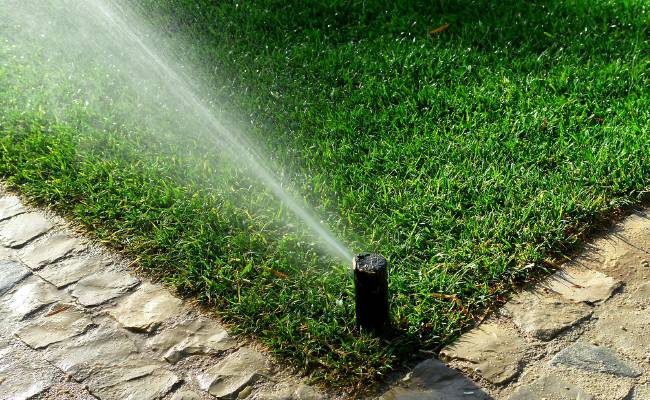
What an Irrigation System Actually Is
An irrigation system is five pieces of equipment working as one system.
The water source. Usually the home’s municipal supply, with a tap upstream of the house and a backflow preventer between the supply and the irrigation lines to keep irrigation water from contaminating the home’s drinking water. Some properties pull from a well; the design changes when the source changes.
The controller. The small box mounted on the garage wall or inside a utility space. It tells the system which zone to run, for how long, and on which days. Modern smart controllers add weather data, soil moisture inputs, and seasonal-adjust features that scale run times automatically as the calendar moves through the year.
The zones. A residential property usually runs between four and twelve zones, each one controlling a section of lawn or planting that needs the same kind of water. Front lawn, side beds, back lawn, drip-irrigated trees, and so on. The zone boundaries are where most amateur designs go wrong; mixing planting types on one zone forces over- or underwatering on at least one of them.
The lines and heads. Buried polyethylene or PVC lines carry water from the manifold out to the heads. Pop-up spray heads for tight residential lawns and beds, rotor heads for longer-throw open lawns, drip lines for established planting where overhead spray would just evaporate or run off.
The backflow preventer. Code-required on every system tied into municipal water. A device that prevents irrigation water from being siphoned back into the home water supply. Annual testing is required in some Indiana municipalities; we handle that as part of the spring startup on accounts we service.
Head Spacing, Pressure, and the Strips That Stay Dry
The single most common irrigation failure mode we walk into is dry strips. A two-foot ring of dead lawn along a fence line, a five-foot strip behind the back patio, a triangle of brown grass at the corner of a property. The cause is almost never the controller and almost never the heads themselves. The cause is head spacing.
Spray heads need head-to-head coverage. The water thrown by one head has to reach the next head over, so the overlap zone gets watered by both. A system designed with head spacing at one and a quarter times the throw distance leaves coverage gaps in every overlap. A system designed with true head-to-head spacing covers every square foot of the zone it serves.
Water pressure decides whether head-to-head spacing actually works in practice. Most residential properties run between 40 and 70 PSI at the supply. A spray head designed for 30 PSI throws a longer pattern at 60 PSI than its spec sheet promises, but pushed too hard the same head will mist instead of stream, and most of the water evaporates before reaching the lawn. We size the system to the actual measured pressure at the property, not the assumed pressure from a generic install spec.
The fix on dry strips is rarely buying more heads. The fix is usually relocating two or three existing heads, replacing nozzle types, and adjusting arcs so the coverage pattern overlaps cleanly. Sometimes a tenth zone needs to be added to break up a zone that was carrying too many heads on one valve. Either way, the work is diagnostic before it is mechanical.

Fall Blowout Is Not Optional Here
A buried irrigation line in Indiana that still has water in it on the day the ground freezes will split somewhere. Polyethylene tolerates more freeze stress than PVC, but every line type fails at some point if it holds water at twenty degrees. The split usually happens in the pipe itself, but sometimes it happens inside a valve body or at a head fitting. The damage is invisible until spring startup, when the line gets pressurized and water comes up through the lawn instead of through the heads.
Fall blowout is the single piece of irrigation service that decides whether the system survives an Indiana winter. The work is straightforward in principle: an air compressor connects to the system, the controller cycles through every zone, and the compressor pushes any remaining water out of the lines and heads. The work is harder in practice because every zone needs to run long enough to clear the line, but not so long that the compressed air overheats the seals on the valves or heads. A bad blowout is sometimes worse than no blowout. Pressure ratings on the compressor matter; volume matters more.
We schedule fall blowouts on a route in October. Properties we serviced for spring startup are already on the route. New accounts get added by call or email request. Skipping a blowout to save the visit cost is a bet against the calendar, and the calendar wins about four years out of five.
When a New System Is the Right Answer
Not every property needs an irrigation system. The decision usually comes down to lawn size, planting investment, and how much water the property would need to look right through an Indiana drought without intervention.
A small lawn on a property with established planting and good soil can usually survive an Indiana summer on rain and occasional hand-watering. A new system on that property is mostly a convenience purchase, and the math on installation cost versus benefit takes a long time to work out.
A property with a major lawn investment, a recent sod installation, new landscape design work that included structural planting, or a long fence line with the planting density that defines the property, usually pays back an irrigation system within two summers. The system protects the investment that is already in the ground.
Properties that are already irrigated but were installed ten or fifteen years ago are usually candidates for partial retrofit rather than full replacement. Heads, valves, and controllers can be replaced and upgraded without re-trenching the entire property if the underlying lines are intact. A site walk usually tells us within twenty minutes which path makes more sense.
Frequently Asked Questions
How does a lawn irrigation system work?
An irrigation system delivers water automatically through a network of underground pipes, valves, and sprinkler heads divided into zones, controlled by a timer or smart controller. Each zone is designed for the water needs and layout of a specific area, lawn, beds, or slopes, so coverage is even and efficient. At Plant Studio Landscape, systems are designed with head spacing, zone layout, and water pressure calculated for the property, which is what determines whether every square foot gets water or dry strips appear along the fence line.
When should an irrigation system be started up and winterized in Indiana?
In East Central Indiana, spring startup happens once the threat of a hard freeze has passed, usually in April, when the system is pressurized, inspected, and programmed for the season. Fall blowout, or winterization, is essential and typically happens in October before the first hard freeze: compressed air is used to clear all water from the lines so nothing freezes, expands, and cracks the pipes or heads. Skipping the blowout is the most common and most expensive irrigation mistake in the Indiana climate.
Will an irrigation system save water or waste it?
Designed and programmed correctly, it saves water compared with hand-watering or moving sprinklers, because it applies the right amount to each zone at the most efficient time of day and only where it is needed. Smart controllers and rain sensors reduce waste further by skipping cycles after rain and adjusting to the season. A poorly designed or unadjusted system, by contrast, can waste water on overlap and runoff, which is why design and seasonal programming matter as much as the equipment.
Can you repair or upgrade an existing irrigation system?
Yes. Many properties in the Muncie area have systems installed by previous crews that were never adjusted to what the landscape became, with heads blocked by mature plantings, zones out of balance, or coverage gaps. Plant Studio retrofits and repairs existing systems, rebalancing zones, correcting head spacing and pressure, and adding smart controls, in addition to designing new systems. An audit of the current system usually reveals quick wins in coverage and efficiency.
Do I need irrigation if I have a new lawn or major planting?
For a significant investment in sod, seed, or new plantings, reliable irrigation is strongly recommended in the East Central Indiana climate, where summer dry spells can stress or kill establishing roots. Consistent water during the establishment window is the difference between a lawn or planting that takes hold and one that struggles. Designing irrigation alongside a new lawn or landscape protects that investment from the start, rather than scrambling to water by hand through the first hot July.
Schedule an Irrigation Walk
A first conversation does not cost anything. We walk the property, check the existing system if there is one, and tell you what we would do and what we would not do. Because how a lawn gets water matters as much as how it gets cut, fertilized, or mulched, and a system that pays attention to the season it is in saves the lawn during the August stretches that decide every year. Call (765) 717-3917 or request a quote and we will get an irrigation walk on the calendar.