
Retaining Wall Design and Engineering for Muncie Properties
There are two retaining walls on every block in Indiana that tell the same story. The first one looks fine. Lines straight, blocks tight, planting at the top still alive. The second one was built the same year by a different crew, and now there is a belly in the middle, a gap at one end, and water that runs down the wrong side every spring. The two walls were not built the same. One was engineered for what it would actually hold. The other was stacked. We build the first kind for homeowners across Muncie and the I-69 corridor from Heekin Park out toward University Avenue and the wider East Central Indiana service area.
What Actually Holds a Retaining Wall Up
At Plant Studio Landscape, every retaining wall project starts with one question Josh Perkins, Landscape Architect, has asked on every site walk for the last two decades: what is the wall actually holding back? A two-foot decorative wall around a garden bed is not the same project as a six-foot structural wall holding a graded slope above a driveway. The numbers matter, and the engineering matters more than the face.
A retaining wall is a beam laid on its side. It resists pressure from the soil behind it, water that builds up in that soil, and the weight of anything sitting on top of the retained area. Four pieces of work decide whether the wall stays vertical at year ten:
The base. A compacted aggregate base, sized for the wall height. A two-foot wall needs less. A six-foot wall needs significantly more. Most failed walls we inherit failed at the base, not at the surface.
The drainage. Water behind the wall is the load the wall was not designed for if drainage was skipped. A perforated drain pipe in a gravel envelope at the back of the wall, daylighted to a discharge point, carries the water around the wall rather than through it.
The structural connection. For block walls, this is geogrid embedded back into the retained soil at specified vertical intervals. For natural stone, this is batter (the inward lean of the face) and weight. Without one or the other, gravity wins over a few winters.
The capstone. A finishing course that seals the top of the wall against water intrusion from above and gives the wall the visual line that reads as finished, not as in-progress.
Wall Types and When Each Fits
Three broad categories cover most residential retaining work in this part of Indiana.
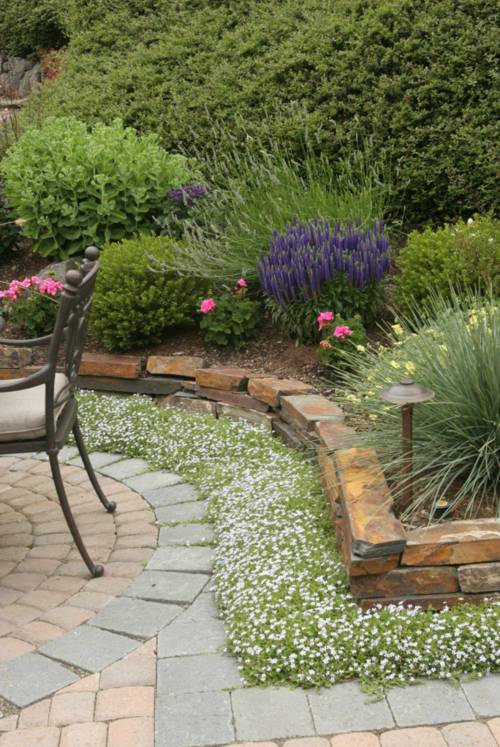
Modular block. Manufactured concrete blocks with built-in setback and geogrid lugs. Predictable engineering, fast install, the most common choice for walls between two and six feet on Indiana residential properties. Color and texture options are wider than they used to be, so a block wall does not have to read as commercial.
Natural stone. Limestone, granite, or local fieldstone, set as a dry-laid or mortared wall. Higher craft, higher cost, and the right call when the wall is a visible part of the landscape composition. Best for shorter walls (under four feet on most properties) or when the project warrants the material upgrade. See hardscape services for stonework that is paired with the wall on a larger property buildout.
Poured concrete or rebar-reinforced structural walls. Engineered structural walls for taller retained slopes, walls supporting driveways or structures, or walls that have to meet specific local code. Less common on residential, more common on properties with significant grade changes. We bring in a structural engineer when the height or load warrants it; we do not pretend that part of the work fits inside a landscape budget.
The choice depends on three things: the wall height, the load above the retained area, and how visible the wall is as part of the finished property. Most projects end up with a clear right answer once those three pieces are on the table.
Drainage Behind the Wall Is What Most Crews Skip
Most retaining walls we inherit from other crews were not under-engineered at the face. They were under-engineered at the back. Water that built up behind the wall pushed the face outward until the wall bellied. Sometimes the failure shows up at year three. Sometimes year seven. The pattern is consistent enough that we can usually tell a wall is going to fail from how the drainage was handled on day one.
Drainage behind a wall is three pieces of work that happen during the build and are invisible after the wall is finished. A drain pipe at the back of the base. A gravel envelope around the pipe. A daylighted discharge that takes the water to a place it can leave the property cleanly. Skip any of the three and the wall is on a clock.
See drainage and grading for the broader yard drainage work that often pairs with a retaining wall project. The wall fixes one local problem; sometimes the rest of the property has the same water-handling problem in different places, and addressing both at once is cheaper than fixing them separately.
Built for the Indiana Frost Line
The freeze line in East Central Indiana sits at roughly 32 inches below grade in a typical winter. That number drives where the base of a retaining wall gets buried. A wall whose base sits above the frost line will heave with the freeze-thaw cycle and lose its line over a few winters. A wall whose base sits at or below the frost line stays put. The first six inches of dirt do not matter to a wall’s longevity; the first three feet do.
This is the difference between a wall built by a crew that works in this part of the country and a wall built from a spec sheet written somewhere else. We dig the base depth Indiana frost requires, not the base depth that fits a tight schedule. The wall pays you back in year five, not in week three of the install.
Frequently Asked Questions
What is the purpose of a retaining wall?
A retaining wall holds back soil to create level, usable space on a sloped property, manage grade changes, and control erosion and drainage. On many East Central Indiana lots it turns an unusable slope into a terraced yard, a level lawn, or a flat area for a patio. Beyond function, a well-built wall is a design element that defines outdoor rooms. At Plant Studio Landscape, a retaining wall is engineered for the load it carries, not just stacked for looks, because a wall that fails is far more expensive than a wall built right.
Why do retaining walls fail, and how is that prevented?
Retaining walls fail for three main reasons: inadequate base, poor drainage, and undersized engineering for the load behind them. Water is the biggest enemy; when it builds up behind a wall and freezes, the pressure pushes the wall out. Prevention means a properly compacted base below frost depth, gravel backfill and drainage pipe to move water away, geogrid reinforcement into the slope on taller walls, and batter so the wall leans slightly into the hill. In the Indiana freeze-thaw climate, drainage and base depth are what separate a wall that lasts decades from one that bulges in a few years.
How tall can a retaining wall be before it needs engineering or a permit?
As a general rule, walls above three to four feet, or walls supporting a structure, driveway, or surcharge load, require engineered design and often a permit, though the exact threshold depends on the Muncie or Delaware County jurisdiction. Taller walls or tiered systems carry serious loads and have to be designed, not guessed. Working with a licensed landscape architect means the wall is designed to the correct specification and permitting requirements from the start, which the site walk identifies before any block is set.
What materials are used for retaining walls?
Common options are segmental concrete block, natural stone, and poured or boulder walls, each with different cost, look, and structural range. Segmental block systems are engineered, modular, and well suited to the freeze-thaw climate. Natural stone is the higher-detail, higher-cost choice. Boulder walls suit certain naturalistic and larger-grade applications. The right material depends on the wall height, the load, the site, and the look you want, which is decided as part of the design rather than off a catalog page.
Can a retaining wall improve drainage on my property?
Yes, when it is designed to. A retaining wall changes grade, and grade is drainage. Built correctly, a wall and its associated grading can redirect water away from a foundation, terrace a slope so runoff slows, and solve a wet or eroding area rather than just holding back dirt. Built incorrectly, a wall can trap water and make drainage worse. Because Plant Studio designs grading and drainage alongside the wall, the wall becomes part of the solution to how water moves across an East Central Indiana property, not a new problem.
Schedule a Retaining Wall Walk
A first conversation does not cost anything. We walk the property, look at the grade change you want to handle and the soil that has to hold the wall, and tell you what we would do and what we would not do. We believe a wall that stays vertical at year ten is worth more than a wall that looked perfect on install day, and we build to that standard from the base up. Call (765) 717-3917 or request a quote and we will get a site walk on the calendar.