
Outdoor Lighting Design and Installation in Muncie, Indiana
Drive through a Muncie neighborhood on a summer evening after the sun has dropped, and one or two properties on every block read differently than the rest. The trees have shape against the sky. A walkway lights to the front step without glaring at the porch. A back patio glows soft enough that you can see across it without losing the planting around the edge. The other properties on the block, the same square footage and the same yard size, fall flat into the dark by nine o’clock. The difference is not money. The difference is whether the lighting was designed or whether it was installed. We design and install outdoor lighting for homeowners from Muncie out through the I-69 corridor, from neighborhoods off Jackson Street to country lots out past the Cardinal Greenway.
How Light Works on a Property
At our work in East Central Indiana, lighting gets treated as part of the design from the first site walk, not as a wiring decision made after the planting and hardscape are in. Josh Perkins, Landscape Architect, has spent two decades looking at properties at dusk before drawing a lighting plan, because the way a yard reads at noon is not the way it reads at nine PM. The mature oak that anchors the front yard at noon disappears at sundown unless something illuminates it from below. The patio that feels open in daylight feels closed-in after dark unless the light extends past the perimeter.
Our lighting work is built around four ideas. Light is a composition, not a fixture count. Fixtures should disappear and the light itself should be the point. Color temperature decides whether a property reads as warm or as institutional, so the choice of bulbs matters as much as the placement. And every fixture on the property needs to come out of one plan rather than four contractors’ opinions stacked over five years. See landscape design services for the broader design context that lighting sits inside.
The Four Ways We Light a Property
Most residential outdoor lighting on properties this size falls into four categories. A complete plan usually uses some of each, with the mix decided by the property’s structure and how the homeowners actually use the yard after dark.
Path lighting. Low-voltage fixtures placed along walkways, garden paths, and entry approaches. The job is to mark the path safely, not to flood it. Spacing matters more than wattage. A well-lit path has fixtures every six to eight feet, set just off the path edge, throwing a low pool that overlaps with the next one. Path lighting that puts the homeowner in pools of light separated by long stretches of dark is the most common installation mistake we inherit.
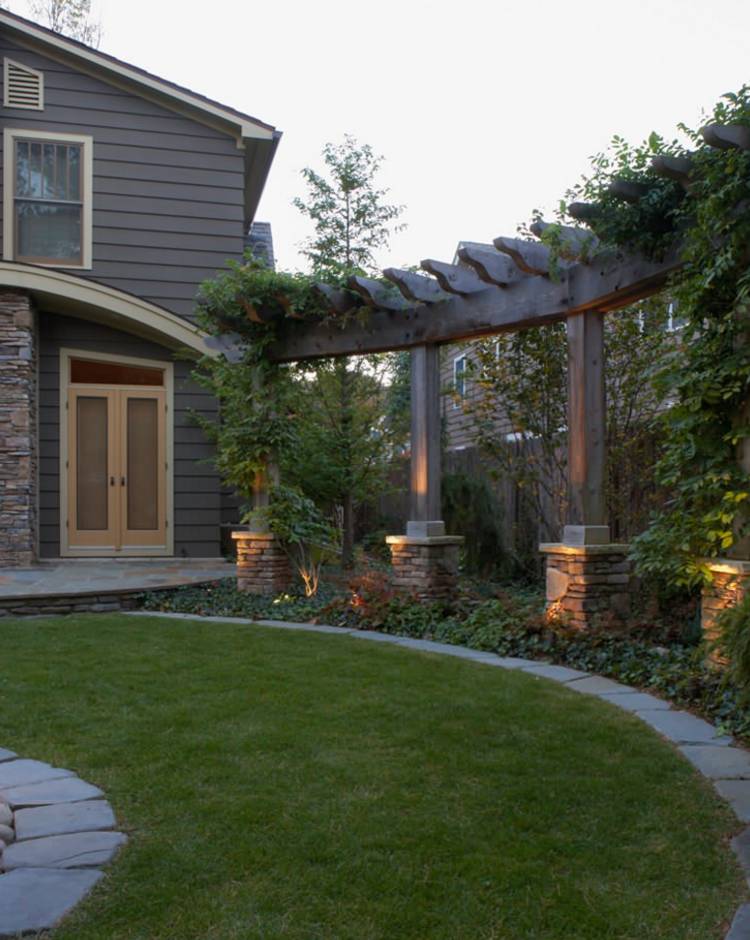
Uplighting. Fixtures buried at the base of trees, walls, and structures, pointing up. This is the part of lighting that turns a property from lit to designed. A mature tree uplit from two angles is the visual anchor of the yard at night. A retaining wall washed with grazing light becomes a feature instead of disappearing into the slope.
Specialty and accent lighting. Step lights built into hardscape risers, downlights inside pergolas or arbors, in-ground washers grazing across a stone face. Smaller fixtures with specific jobs. Usually four to ten on a typical property, placed where the eye expects light without expecting to see the fixture itself.
House-mounted and hardwired. Floodlights, sconces, post lights, and any fixture wired into the home’s electrical service. This is the older lighting layer most properties already have. We work it into the new plan rather than fighting it, when the fixtures can be matched to color temperature and integrated cleanly with the low-voltage system.
Low Voltage and Hardwired Run on the Same Property
The two systems are not in competition. A complete lighting plan usually runs both, with each handling the work it does best.
Low-voltage landscape lighting is the workhorse for almost every plan we build. A transformer at the house steps the 120-volt line down to twelve volts, and a buried cable runs out to the fixtures across the property. Twelve-volt fixtures use roughly a tenth of the wattage of hardwired equivalents, can be added or relocated later without rewiring, and run cooler so the fixtures themselves last longer. The bulk of path lighting, uplighting, and accent work on Plant Studio properties is low voltage.
Hardwired lighting stays where it makes sense. House-mounted sconces and floods, post lights at the end of long drives, and structural overhead lighting inside pergolas or covered outdoor kitchens where the run from a transformer would be impractical. Hardwired runs require an electrician on the build and a permit if the work goes beyond replacing an existing fixture.
The transformer sizing on the low-voltage side decides whether the system has room to grow. We size transformers at roughly seventy percent of fixture load rather than at maximum capacity, which leaves headroom for adding fixtures in year two or year five without replacing the transformer. A system installed at one hundred percent capacity has no growth room and starts dimming when a sixth uplight gets added to a five-uplight load.
Why Most Yards Are Lit Wrong
Most outdoor lighting installed on residential properties in the last two decades was installed one fixture at a time, by different crews, with no plan tying it together. The result is predictable. Too many fixtures pointed at the same area. Wattage that worked for the first three fixtures but overloaded the transformer once two more got added. Color temperature that swings from yellow at the path lights to blue-white at the floodlights, so the property reads as four different jobs rather than one finished yard.
The single most common fix we make on properties we inherit is bulb replacement. A property with twenty-five fixtures and three different color temperatures looks chaotic at night even when each individual fixture is doing its job. Matching everything to the same warm color, usually around 2700 Kelvin, turns the same set of fixtures into a coherent plan without changing a single placement.
The second most common fix is fixture aiming. A path light pointed at the path is doing its job. A path light pointed sideways at the homeowner’s face every time they walk up is creating glare. Aiming and shielding fix more lighting complaints than buying more fixtures ever does.
Built for Year-Round Indiana Conditions
Indiana dusk swings from five PM in December to nine PM in June. A lighting plan that works on June fourth fails on December twentieth if it was not designed around the full season. We set astronomical-clock photocells so the system follows the actual sunset rather than running on a fixed timer. The lights come on at dusk year-round, run the schedule the homeowner set, and shut down without intervention.
Indiana winters are also hard on fixtures. Plowed snow piles against path lights at the edge of a driveway. Salt and brine work into the bases of fixtures placed near salted walkways. We use brass and copper fixtures where corrosion exposure is high, set lens covers to shed water away from the bulb, and bury low-voltage lines below the frost line where the ground is going to freeze hard.
The transformer mounted on the house gets covered with a weatherproof enclosure rated for the Indiana freeze-thaw cycle. Twelve months of weather on a transformer chosen for a warmer install is the most common failure point we see on systems homeowners bought online and installed themselves.
Frequently Asked Questions
What types of outdoor landscape lighting are there?
The main categories are path lighting for walkways and steps, uplighting to highlight trees and architectural features, downlighting or moonlighting from above for a soft natural wash, wash lighting for walls and facades, and task lighting for kitchens and gathering areas. A good design layers these rather than relying on one type, so the property has depth and safety after dark. At Plant Studio Landscape, lighting is treated as a design layer on the whole landscape, not a string of fixtures added at the end.
Is LED landscape lighting worth it?
For nearly every property, yes. LED fixtures use a fraction of the energy of older halogen systems, last far longer, and run cooler, which matters for fixtures tucked into planting. Modern LED systems also offer warm color temperatures that flatter a landscape and controls for zones, timers, and dimming. The higher up-front cost is offset by lower energy use and minimal bulb replacement over the life of the system, which is why it is the standard for quality installations in the Muncie area.
Will outdoor lighting work through an Indiana winter?
A properly installed low-voltage system is built to run year-round in East Central Indiana, including snow and freezing temperatures. The transformer, wiring, and fixtures are rated for outdoor and buried use, and connections are made to keep moisture out. Fixtures are placed and wired with frost and mowing in mind. In fact, landscape lighting earns its keep in winter, when the days are short and a well-lit property is both safer and more striking against the snow.
How much does landscape lighting cost?
Cost depends on the number of fixtures, the size of the property, the quality of the system, and the complexity of the design and controls. A focused entry or accent project is a modest investment, while lighting a full property with layered effects is larger. Quality matters here: a professional low-voltage system with quality fixtures and proper transformer sizing costs more than a big-box kit but lasts and performs far longer. A site walk after dark, or a review of the plan, is the best way to scope it honestly.
Can lighting be added to an existing landscape, or only a new build?
It can be added to an established landscape at any time. Low-voltage wiring can be routed through existing beds and lawn with minimal disruption, so a mature Muncie-area property does not need to be torn up to be lit. Lighting is also designed into new builds from the start, which lets the wiring run cleanly during construction. Either way, the goal is the same: a property that keeps working past sunset, safer to move through and better to look at.
Schedule a Dusk Walk
A first conversation does not cost anything. We walk the property at the hour you actually use it, look at how the yard reads at dusk, and tell you what we would do and what we would not do. We believe a yard you keep using after sundown is worth more than a yard you abandon when the porch light comes on. Call (765) 717-3917 or request a quote and we will get a dusk walk on the calendar.